Why a Paper Clip Springs Back After You Bend It
Why a paper clip springs back depends on its looped wire and the metal’s elastic range. Learn why gentle flexes recover while sharp bends can stay put.
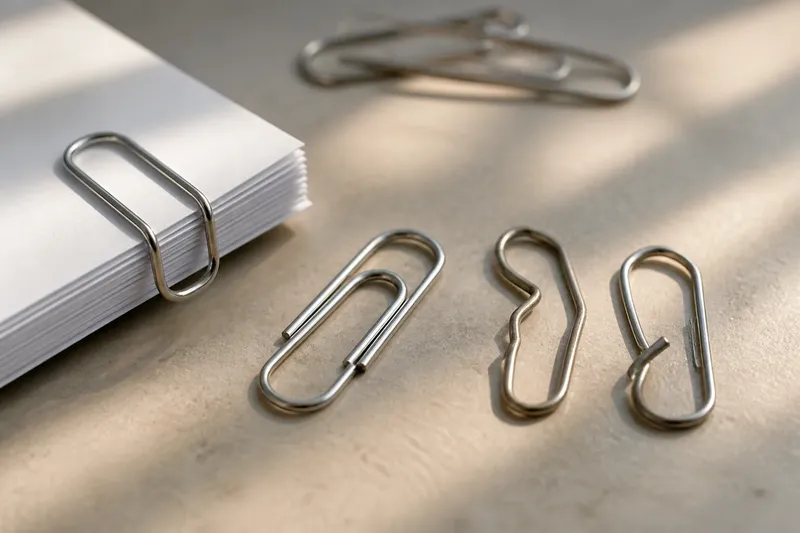
The common mistake with a paper clip is to bend it wherever convenient, then expect it to hold its shape as before. A kink or loose loop can cost the clip its grip. Why a paper clip springs back depends on the wire’s shape and on how far it has been bent.
The familiar loops are functional, not decorative. They give a short length of metal a route for sharing movement while pressing against both sides of a paper stack.
How does a paper clip’s shape help it spring back?
An ordinary metal paper clip follows a pair of rounded turns. When you press a loop, several nearby sections can change curvature; the movement is not confined to one abrupt corner. A coiled spring offers a plain analogy: its turns share a compression instead of folding at a single point.
Not every part of the clip bends equally. The section being squeezed moves most, while nearby curves respond according to their shape and how the wire is held. A rounded turn leaves room for curvature to change; a tight corner concentrates the movement.
The loops also let the clip wrap around a paper edge and press sheets together from both sides. A straight wire would need to be bent into a hook to do similar work, and hooks are poor at keeping their manners.
What happens inside the wire when it bends?
When force bends the wire, its atoms shift slightly from their usual arrangement. Within a limited range, the metal resists that change and tends towards its earlier shape once the force is removed. This reversible response is called elastic deformation.
The outside of a curve is stretched while the inside is compressed. Between them is a region where the length changes little. These opposing changes help the wire resist a bend, though they do not make it immune to lasting deformation.
A paper clip is one continuous piece of wire, unlike a folding ruler with joints. Its shape guides where movement can occur, but both the material and the geometry affect how it responds.
Why do some bends stay in place?
A gentle flex may remain within the wire’s elastic range, allowing it to recover much of its previous shape. A sharper bend, particularly one concentrated at a single point, can exceed that range and leave a lasting kink or an open loop.
The result depends on the amount of movement, where the force is applied and the wire’s condition. Repeated bending at the same spot can, under some conditions, contribute to damage or cracking; the effect depends on the material, the size of each bend and how often it is repeated. A clip that has been twisted repeatedly should not be treated as though it were undamaged merely because no crack is visible.
Imagine a clip whose inner loop has opened slightly and no longer catches a thin stack. If you nudge the loop gently across its curve, it may settle closer to its former shape; if you fold the wire sharply at the nearest corner, that corner may remain flattened. The expected visible difference is a smoother curve after the gentle adjustment or a persistent kink after the sharp fold. Neither outcome proves the wire is free of hidden damage.
What makes one paper clip respond differently from another?
Clips vary in wire thickness, size, shape and finish. A thicker wire will often need more force to bend than a thinner one, while a larger loop may give movement more room to spread. These are tendencies, not a reliable way to identify a clip’s exact properties by appearance alone.
Metals differ in stiffness and capacity for elastic recovery, and the forming process affects the wire’s shape and condition. A coating can be scratched or damaged by repeated handling, but it does not turn the wire into a different kind of spring. A coated jumbo clip and a small bare-wire clip share the same broad principle, not necessarily the same response.
What can a paper clip’s bend tell you?
Release a mild flex and observe whether the clip returns towards its previous shape. A visible kink after release indicates that at least part of the wire has taken a lasting set. These observations are qualitative: they cannot identify the metal or show whether a fine crack is present.
For ordinary use, let the existing curves do the work. Slide the clip over paper rather than reshaping it into a hook, and avoid repeatedly opening the same loop. If it has lost its grip or looks cracked, replace it rather than relying on another bend.
What do people ask about why a paper clip springs back?
Why does a paper clip return to its original shape?
The wire resists small changes through elastic deformation. When the force is removed, it tends towards its earlier shape, although it may not return perfectly.
Why does a paper clip stay bent sometimes?
A sharp or concentrated bend can exceed the wire’s elastic range and leave a lasting change. Repeated bending in one place may also contribute to damage, depending on the wire and the way it is handled.
Does the looped shape make a paper clip stronger?
The loops help distribute movement and grip paper, but they do not make the wire unbreakable. Its response also depends on the material, thickness, shape and force applied.
Can a bent paper clip be bent back?
A slight adjustment may restore some grip, but another bend can leave a kink or add to existing damage. Replace a visibly cracked or badly deformed clip instead of relying on it.
Why a paper clip springs back is best understood as a matter of degree: the wire can recover from some flexes, but not every shape change is reversible. A clip that returns to its old outline gives you a useful observation, not a certificate of its condition.