Borrowed Words or Calques: Two Routes Into a Language
Borrowed words or calques reveal whether a language imports a word’s sound or rebuilds its parts, helping you distinguish a plausible guess from a documented history.
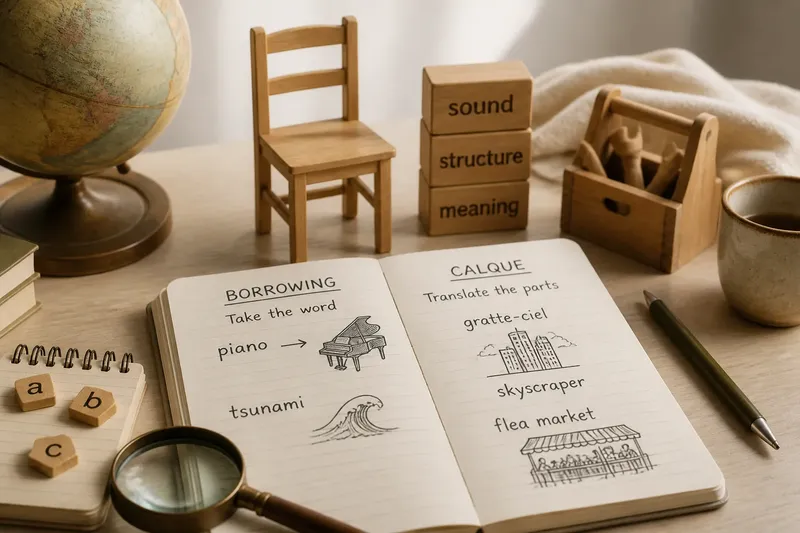
The common mistake with borrowed words or calques is to treat them as the same kind of import. That blurs a useful distinction: a language may take a foreign word in a recognisable form, or translate its parts and assemble a local equivalent. The difference is easy to spot in some cases and much harder to prove historically.
What crosses the border: sound or structure?
A direct borrowing brings a word into a language from elsewhere. English piano came from Italian with its form largely intact, though English speakers give it their own pronunciation and use it within English grammar. A borrowed word need not be copied perfectly; sounds, spelling and endings can settle into local habits.
A calque, also called a loan translation, borrows a word’s structure or meaning rather than its sound. The receiving language translates an expression’s parts using its own words. French gratte-ciel and English skyscraper are often treated as corresponding expressions: each combines words meaning roughly “scrape” and “sky”. Their close match is suggestive, but the resemblance alone does not establish which expression influenced the other or the precise route either took.
Think of the difference as bringing home a finished chair versus making one from local timber using a borrowed design. The first keeps more of the original object; the second recreates its arrangement. Neither route is more linguistically pure. A language is not a sealed cupboard, and its speakers rarely ask permission from the inventory.
How can you tell which route a word took?
Look at the word’s form and its internal parts. If its form resembles a word in a contact language and cannot be sensibly divided into familiar local elements, direct borrowing is one possibility. If its parts map neatly onto an expression in another language, a calque may be involved.
These are clues, not verdicts. A borrowed word can be reshaped until it looks local, while a close translation can arise independently. Etymological dictionaries and historical records may help trace a word’s path, but a tidy match does not establish who copied whom. Words can also travel through an intermediary language, leaving the apparent source one step away from their actual route.
Grammar offers another clue. Borrowings can retain a recognisable foreign stem while acquiring local endings, plural forms or verb patterns. English speakers can say to email, turning a borrowed noun into a verb; adding an English verb ending does not make the formation a calque.
Why do speakers choose one route rather than the other?
A new object or practice may arrive with a name already attached. Borrowing that name is convenient, especially when speakers encounter it through trade, travel, specialist work or popular culture. English tsunami came from Japanese, carrying a name for a kind of sea wave rather than being rebuilt from English words.
A calque can appeal when speakers want an expression that fits local vocabulary or makes its parts legible. English flea market is commonly traced to French marché aux puces. The English phrase uses ordinary English words, yet its history is associated with a translated expression. For a speaker unfamiliar with French, it may simply feel like an obvious name.
Institutions may encourage local terms in education, public administration or technical writing, but an official preference does not settle everyday usage. Speakers may adopt a translated form, keep a borrowed one, or use both with different shades of meaning. The route that looks neatest on paper can still lose to the word people already say.
Can one expression involve both routes?
Yes. The categories describe ways forms travel, not sealed compartments for every word. An expression can be translated at first and later contain borrowed material, or a borrowed word can be combined with local elements. Linguists also use loanblend for formations that mix imported and local parts.
Imagine a community that already uses a borrowed technical noun, then adds a familiar local word to name a related tool. The resulting compound combines imported material with local structure. That identifies a mixed formation in this imagined situation, but it does not explain when or why speakers settle on it.
It also helps to distinguish a calque from a semantic loan. In a semantic loan, an existing local word acquires an additional meaning under the influence of a foreign word with a similar sense. The form is not translated piece by piece; its range of meanings expands.
What questions help identify a calque or borrowing?
Is a calque always a literal translation?
No. A calque often translates recognisable parts, but the result may be adapted to local grammar or word-building habits. “Literal” is a useful first impression, not a demand that every piece line up mechanically.
Can a borrowed word change its pronunciation?
Yes. Speakers fit unfamiliar sounds and spelling patterns to the receiving language, so a borrowed word may become less recognisable over time. Adaptation does not cancel its borrowed origin.
Can a calque sound completely native?
Yes. Its ingredients are local words, and the expression may feel ordinary to speakers who do not know its source-language model. Etymology describes a history, not how foreign a word feels today.
How do dictionaries distinguish the two?
They compare historical forms, meanings and patterns of use across languages. Where the evidence is uncertain or routes are indirect, a careful account should say so rather than turn resemblance into a confident origin story.
What should you check before calling something a calque?
- Check whether the expression’s parts have clear local meanings; if they do, consider a calque, but if they do not, investigate borrowing or another formation.
- Check whether a closely matching expression exists in a plausible contact language; if it does, treat that as a lead, but if it does not, avoid claiming a calque on resemblance alone.
- Check dated forms in an etymological dictionary or historical text; if they support a sequence of influence, report that cautiously, but if they do not, leave the direction unresolved.
- Check whether the word’s sounds and spelling resemble a form in another language; if they do, consider direct borrowing, but if the resemblance is weak, look for other explanations.
- Check for local endings or changes in word class; if they attach to a recognisable imported stem, describe adaptation, but if the expression translates separate parts, consider a calque instead.
- Check whether an intermediary language is documented or plausible; if it is, include that possible route, but if evidence is absent, do not invent an intermediary.
Say you encounter French gratte-ciel beside English skyscraper in a bilingual dictionary. You note that their parts suggest comparable images, then consult an etymological reference for dated forms and accounts of influence. If the reference supports a direction, you can describe that account with appropriate qualification; if it does not, the sound conclusion is that the expressions correspond, while their historical relationship remains uncertain.
Borrowed words and calques reveal two different kinds of contact: a language may welcome a ready-made sound, or rebuild an expression with its own materials. The search phrase “borrowed words or calques” points to that distinction, but it cannot settle a word’s history by itself. Start with the form, then let historical evidence—not an appealing translation—decide how confidently to describe its route.