The Rainbow Is Not a Painted Band in the Sky
Learn why a rainbow is not a fixed band, and use a simple viewing routine to see how sunlight, raindrops and your position shape its appearance.
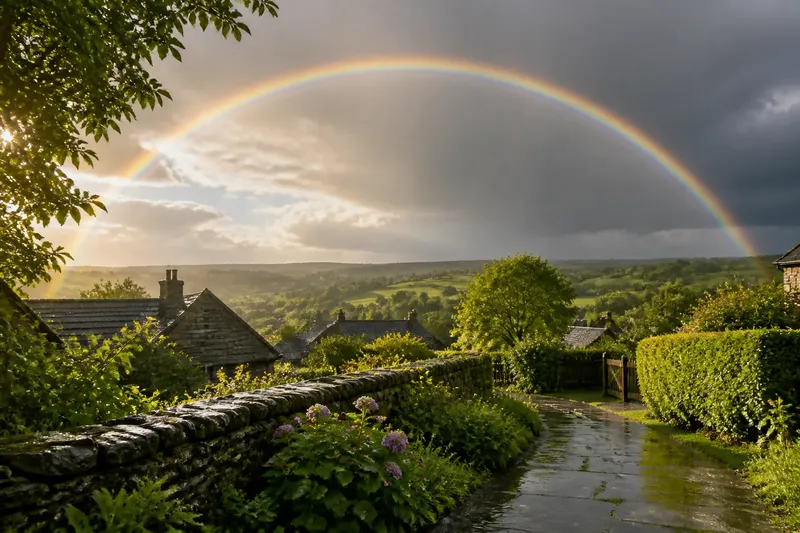
The common mistake with a rainbow is to treat it as a painted band sitting over a field, then assume it will stay put while you walk towards it. That picture costs you the chance to notice what is actually happening: sunlight is being redirected by raindrops, and the view changes with the observer. A rainbow is not a solid object you can approach; it is a pattern of light arriving from a particular direction.
A useful way to see this is to spend a morning watching the conditions change, rather than chasing the coloured arc. You need no special equipment: a window, a patch of rain, a safe outdoor viewpoint and a little patience will do. The aim is not to make a rainbow appear on demand, but to understand why it appears where it does.
What does a rainbow need to appear?
Sunlight looks white, but it contains colours that bend by different amounts as they pass into and out of water. When sunlight enters a raindrop, it changes direction, reflects inside the drop, then bends again as it leaves. The separated colours travel towards an observer from a particular range of directions.
For the familiar primary rainbow, the sun needs to be behind you and rain or water droplets in front of you. The bow appears opposite the sun, with red on the outer edge and violet on the inner edge. The sun’s position also sets the arc’s height: with the sun high, the visible bow is lower; with the sun low, more of the arc may rise into view.
Clouds can obscure the sun or the rain, and a shower can pass through only part of the sky. That is why the ingredients may be present without a clear bow appearing. You are looking for a particular alignment, not simply for “sun and rain” somewhere nearby.
Why does the rainbow seem to move?
Each droplet sends coloured light towards some viewing positions and not others. Move sideways, and different droplets send the relevant light to your eyes. The arc appears to shift with you, much as a reflection in a window changes when you move across a room.
There is no single set of droplets that makes the rainbow for every person. Someone standing a short distance away sees light from a different collection of drops, so their rainbow is, in that practical sense, their own view. The droplets are real; the coloured arc is the visual pattern formed by light reaching an observer from them.
Say you are standing beside a garden path with the sun behind your shoulder and a shower crossing the far end. If you take a few careful steps to one side, the bow may appear to slide across the hedge or change its apparent centre. The rain has not painted a new stripe there; your position has changed which light reaches your eyes.
How can you watch a rainbow over one morning?
Use the morning as a simple viewing routine, checking the sky at natural changes rather than staring at it continuously. Do not look directly at the sun. A shaded spot, a window or a building that blocks the sun from your view can help you watch the rain safely while keeping the light source behind you.
- At the first passing shower: note whether the sun is visible behind you and rain lies ahead. If either is missing, wait for the cloud or shower to shift.
- When a bright gap opens: scan the sky opposite the sun, starting low if the sun is high and higher if it is near the horizon.
- If an arc appears: notice which side is red and which is violet, then compare the bow with a fixed feature such as a roofline.
- When you change position: move only where the ground is safe, and see whether the bow’s apparent place changes relative to that feature.
- As the shower passes: watch whether the bow fades, breaks into sections or becomes clearer as the balance of sunlight and droplets changes.
- Before the morning ends: check the opposite side of the sky once more after another patch of rain, rather than assuming the first rainbow was attached to that shower’s location.
Keep the observations modest. A phone photograph can record the cloud arrangement, but a camera may show colours differently from your eyes, and its framing cannot establish where the rainbow “really” is. Your own changing viewpoint is the more useful instrument.
Why is a rainbow an arc rather than a full circle?
The light from the relevant droplets reaches your eye along directions that form a circle centred opposite the sun. From the ground, the horizon and nearby objects usually hide the lower part, leaving the familiar arc. From a high viewpoint with droplets below, more of the circle can sometimes be visible.
The rainbow’s apparent centre is not the centre of a distant object. It lies in the direction opposite the sun, and its position changes as the sun or observer changes position. A rainbow is therefore less like a coloured fence and more like a circle of light you see only from the right place.
What do people often ask about rainbows?
Can you reach the end of a rainbow?
No fixed end waits at a particular spot. As you move, the droplets sending light to your eyes change, so the visible arc shifts with your viewpoint rather than sitting on the ground ahead.
Why does the rainbow disappear so quickly?
The sun may go behind cloud, the rain may move, or the droplets may no longer line up with your viewing direction. Any of those changes can weaken or remove the pattern from your view.
Can two people see the same rainbow?
They can see bows in the same part of the sky, but each person receives light from a different collection of droplets. Stand apart and compare the bow against a roof or tree: the apparent position may differ.
What is a double rainbow?
A second, fainter bow can form when light reflects twice inside droplets before leaving them. Its colours appear in the reverse order, with red on the inner edge and violet on the outer edge.
What should you remember next time?
The next time a rainbow appears, first locate the sun behind you and the rain ahead. Then notice how the arc sits opposite the sun and whether it changes as you shift your stance. That small check makes the central point plain: a rainbow is not a painted band in the sky, but a moving pattern created by sunlight, droplets and the place from which you look.
If the bow fades before you have finished watching, nothing has gone wrong. The alignment has changed, which is precisely what the morning’s observation was there to reveal.