A Pocket Notebook for Questions on the Move
A pocket notebook for questions on the move helps you capture curiosity in brief phrases, then sort what you can observe, explain or leave open.
The common mistake with a pocket notebook for questions on the move is trying to answer each question before you have even written it down. That turns a small notebook into a stalled research project, and the question that caught your attention often disappears beneath a hurried explanation. A better method is to record a few useful words now and decide later what kind of question you have.
This is not a diary or a miniature filing cabinet. It is a temporary landing place for things that make you pause: why a kettle lid rattles, why one pavement tree has a pale ring around its trunk, or why a familiar word sounds odd when repeated. The notebook earns its keep by preserving the question, not by making you look unusually organised.
What should you write while the question is fresh?
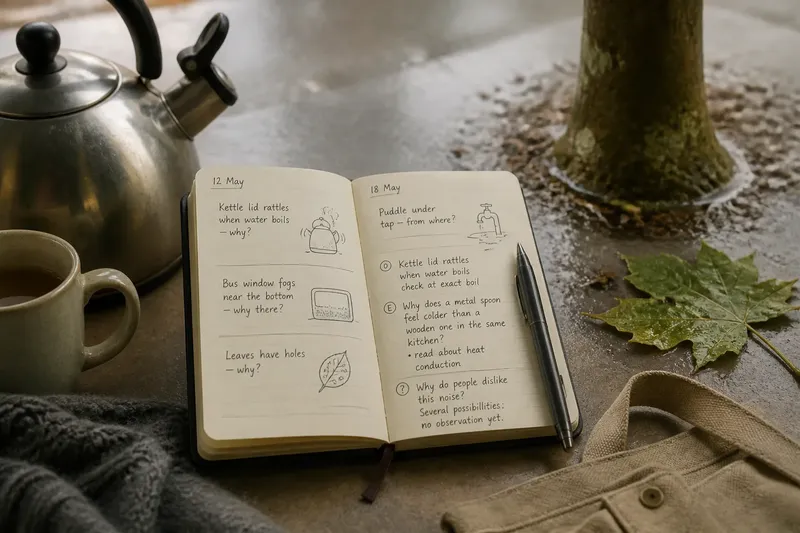
Write a phrase that will let your later self recognise what caught your attention. “Kettle lid rattles when water boils” is more useful than “kettle”; “why do some leaves have holes?” is more useful than “leaves”. You do not need a polished sentence, background notes or an answer.
A compact entry can contain three parts: the thing, the observed detail and the question. For example: “Bus window fogs near the bottom — why there?” The dash is not a formal system; it simply keeps the observation beside the curiosity that grew from it.
If there is an obvious place or circumstance, add a word or two: “station platform”, “after rain”, “old jumper”. These clues can matter later, but they should not become a demand to take notes on everything around you. A notebook is a sieve, not a second head with a clipboard.
Keep the entry short enough to make while standing in a queue or walking somewhere safe to pause. If the detail needs a sketch, use a quick outline rather than a careful drawing. The aim is recognition later, not a field record fit for a museum drawer.
Which kind of question have you caught?
When you return to your notes, sort each question into one of three broad groups. The labels describe what you can do next, not the worth of the question. One entry may move between groups as you learn more.
- Observable: You can look, listen, compare or keep a simple record of what happens. “Does the kettle lid rattle only when the water reaches a boil?” belongs here.
- Explainable: The question asks for a mechanism, convention or cause that can be investigated through reliable explanations. “Why does the lid rattle?” may lead to an account of moving steam and a loose-fitting lid.
- Still open: The wording is too broad, the evidence is incomplete, or several explanations remain plausible. “Why do people dislike this noise?” may depend on different listeners and circumstances.
These are not sealed compartments. A question about an observable pattern can point towards an explanation, while an explanation can leave a new question open. Think of the labels as trays on a desk: useful for keeping papers apart, not a claim that the papers can never move.
Should you sort questions on the page or later?
There are three sensible ways to organise the notebook: leave entries in date order and add a mark later, reserve pages for categories, or keep a running index. Each suits a different kind of note-taker, and none is improved by requiring more administration than the questions themselves.
Is date order enough?
For occasional notes, write each question on the next blank line and add a small mark when you revisit it: O for observable, E for explainable or ? for still open. This preserves the order in which you noticed things and needs no advance planning. It suits someone who wants to capture thoughts without choosing a filing system in the street.
Its drawback is that related questions may be several pages apart. If a later note changes how you understand an earlier one, add a page reference beside it rather than copying the whole entry. Duplication is a reliable way to make a notebook look busy while making it harder to trust.
Would category pages be easier to scan?
Reserve a few pages for each kind of question if you often return to your notes and prefer a quick visual overview. A simple three-part division works with a slim notebook: use the first pages for an index, then mark sections with tabs, coloured pencil or unobtrusive symbols. This approach suits someone whose questions tend to gather around recurring interests.
The cost is that a question may resist its assigned home, especially before you know whether it is observable or explainable. Leave room to move it, or record it in date order first and add a category mark afterwards. The notebook should accommodate uncertainty rather than punish it.
When does a running index help?
An index is useful when the notebook fills with scattered notes and you want to find a topic without flipping through every page. Add a keyword and page number only when an entry seems worth revisiting, such as “window fog — 12”. It suits a reader who returns to questions often enough that retrieval matters more than keeping every page immediately searchable.
Do not index every passing thought. If the index grows more eagerly than the notes, it has become a small bureaucracy serving no obvious public.
How can you sort a question without pretending it is settled?
At the end of a day or whenever you next have a quiet moment, reread a handful of entries. For each, ask what you actually saw, what would count as a useful explanation, and what remains unclear. Keep the answers brief; sorting is a second look, not a requirement to conduct a full investigation.
Say you have written, “Puddle under the garden tap — from where?” Later, you notice the ground is damp around the tap’s base, but you have not seen water escape while it is running. Mark the entry observable, note “check after tap use”, and leave the source open until there is something more definite to record. The useful result is a clearer next observation, not a confident guess.
For an explainable question, record the part you want explained before looking for an answer. “Why does a metal spoon feel colder than a wooden one in the same kitchen?” is more focused than “why is metal cold?” When you do consult a book or dependable reference, add a short note about the explanation and the source, so your memory does not later present a half-remembered answer as something you observed yourself.
For questions that remain open, preserve the uncertainty in plain language: “Several possibilities; no observation yet.” You can also narrow the question. “Why do people like music?” might become “What makes this tune easy for me to remember?” A smaller question is often easier to investigate, though it may not explain the larger one.
How do you choose the right notebook method?
Choose based on the moment you tend to notice things and how often you expect to return to them. If you mostly write a few notes and rarely revisit old pages, date order with later marks is the lightest option. If you build clusters of related questions, category pages make comparison easier. If you regularly search back through a thickening collection, a modest index earns its place.
You can change methods without starting over. Begin with consecutive entries, then add category marks when a pattern emerges; add an index only when finding old notes becomes troublesome. A pocket notebook is a working tool, not a contract with your former self.
Choose a size and binding that you can carry without turning each question into a decision about stationery. A small stitched notebook, a pocket-sized ring notebook or folded paper kept in a wallet can all do the job. Use a pencil if you like revising entries, or a pen if that is what you already carry; the useful feature is that the note survives the walk home.
What questions do readers often ask?
How long should a notebook entry be?
Usually one line is enough if it preserves the object, the detail and the question. Add a brief context clue when it would help you recognise the scene later, but do not write the answer before you know it.
Should I write down every question I notice?
No. Record the questions that hold your attention long enough to be worth revisiting. A selective notebook remains readable, and leaving a passing thought unwritten is not a failure of curiosity.
What if I cannot tell whether a question is observable or explainable?
Leave it unclassified until you have a better sense of what it asks. You can first note what you would be able to see or compare, then decide whether the question also needs an explanation beyond your observations.
Can I use a phone instead of paper?
Yes, if opening a notes app is quick and the entry will not vanish among unrelated reminders. A paper notebook suits readers who prefer a dedicated place and a glanceable page; a phone suits those who already capture short notes there and can find them again.
What makes a pocket notebook worth keeping?
A pocket notebook for questions on the move is most useful when it separates noticing from explaining. Capture the question in a phrase, sort it later as observable, explainable or still open, and choose the lightest filing method that lets you find it again. The page need not resolve every curiosity; it should leave you with enough of the original detail to ask a better question next time.
When a note has been answered, add a short explanation or a pointer to where you found one, then let the page stand. When it has not, leave the question open without dressing uncertainty up as a conclusion. Either way, the small record does its modest job: it gives an interesting thought somewhere to wait while you get on with the walk.